
Insights
Study refinement
Pressure-test questions, screeners, and discussion guides before launch.
Example prompt
When you read that question, what do you think we're actually asking?

Coridor brings synthetic personas into the research tools you already use, so you can test more ideas and decide what’s worth taking into human fieldwork.
Synthetic participants built on real human data. Each one thinks, feels, and remembers like a real person.
Build your study in the tools your team already uses, then add Coridors to pressure-test it before human fieldwork begins.
They appear as a separate synthetic segment — easy to compare against human validation later.
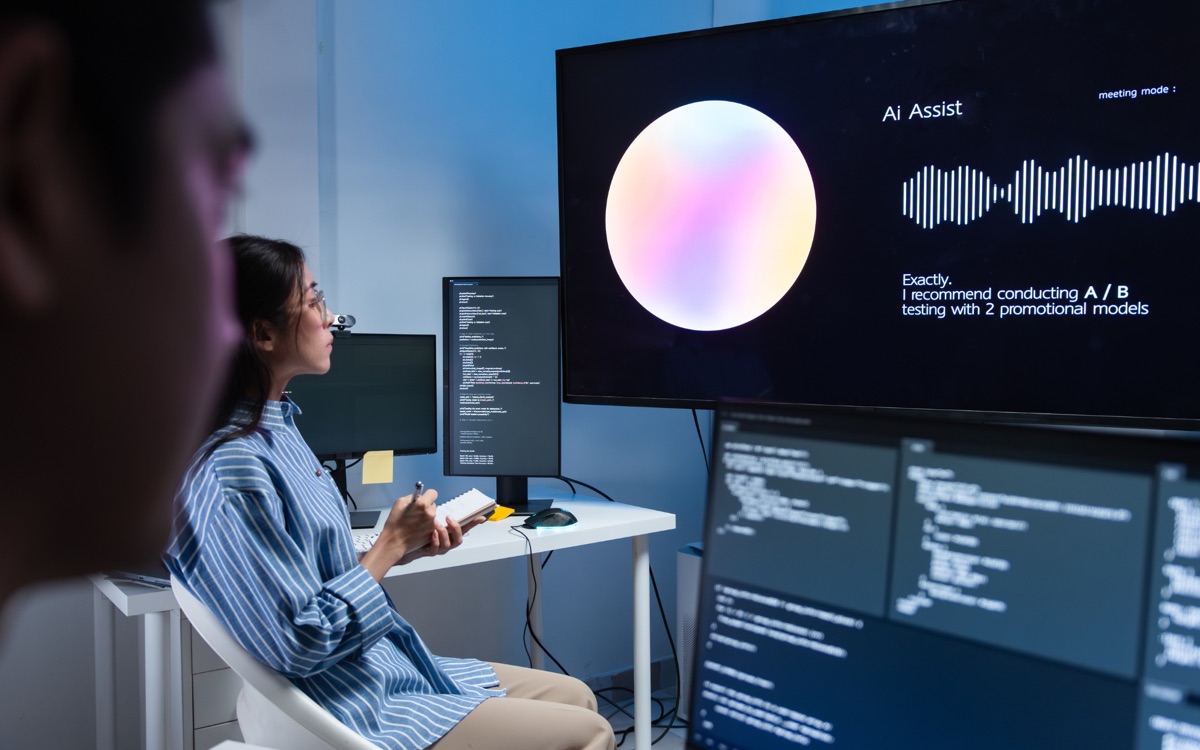
Drive it from the AI assistant your team already uses — Coridor connects over MCP and spins up a live artifact that deep-links into your panel data. Bring your own assistant; we don’t replace it.
Step by step
Future workflow concept. Interface shown for illustrative purposes.
Run my Qualtrics pricing survey past 240 lapsed enterprise buyers — US, college grads, $100k+ HHI, mixed race.


Across every function that shapes what enterprises decide to build, launch, and say, there’s more to explore than live research can reach. Select a function to see what Coridor can do for your team.
Pressure-test questions, screeners, and discussion guides before launch.
When you read that question, what do you think we're actually asking?
Explore motivations, objections, and contradictions before live IDIs.
Walk me through the last time you switched. What finally made you do it?

Identify what deserves human research before fieldwork begins.
How sure are you about that, and what would have to change your mind?
Great research is rigorous, and that rigor costs time and budget — so teams can only put a few ideas through it. Coridor widens the front of the funnel: pressure-test far more ideas in minutes, then send the strongest into human validation. You end up doing more research, not less.
Synthetic personas can drift. We built continuous reality anchoring into the core of the system — so Coridors keep saying what real people actually would. The figures below are targets we hold the system to and benchmark continuously.
At regular intervals we run head-to-head evaluations — Coridors vs. real humans, matched on demographics, answering the same questions. We measure calibration, distributional fit, human preference, and consistency.
Coridor · Preregistered evaluation protocolsTarget · response time, warmed up
We are building Coridors to respond in real time once warm — fast enough for interactive, conversational research.
Target · storage reduction via MDOD
Memory Depth on Demand keeps each persona's history coherent while cutting the cost of carrying it.

Synthetic data represents a powerful new era of market intelligence and decision-making in business.


‘Stand-in consumers’ can be used to quickly evaluate new product concepts.

Synthetic data, powered by AI, is poised to transform the market research industry. The question isn’t if, but when and how.
Every Coridor runs on Atrium — the cognitive architecture between a question and an answer. It takes in a prompt and integrates personality, emotion, memory, and judgment into one coherent response.
That is the difference between a synthetic participant and a clever prompt: the personality lives in the architecture, grounded in decades of published behavioral research and validated against real human responses.
This is who we aspire to be, written down before Coridor was a product. We won’t always meet these, because this is a real industry with real constraints, but they’re the standard we hold ourselves toward: the same RQE bar (reliability, quality, efficiency) we keep inside, carried outward to the people our work represents.
As the world grows more digital, someone has to keep sight of what is distinctly human. We intend to be that place.
We are not chasing artificial general intelligence, synthetic emotion, or machine sentience. Our work points the other way — toward human perspective, human feeling, and the texture of how people actually think and decide.
We measure ourselves by whether our work genuinely serves the people it describes.
Modeling human attention, emotion, and behavior can do real good — stronger education, healthcare, and accessibility. Used carelessly, the same understanding can exploit the very vulnerabilities it learns to see.
We build to support people and strengthen their capacity to make free, informed decisions about their own lives — never to manipulate it.
We build and validate our synthetic personas only on human qualitative data. We do not use synthetic data to create them or to judge them — our benchmarks are human benchmarks.
Our test for any output is simple: if it does not reflect something true about real people, it is not good enough.
Coridors are not real people. They should never be presented as real participants, used to fabricate testimonials, or treated as a substitute for lived human experience.
When synthetic output is used, its source should be clear.
Coridor models patterns across whole populations, not copies of specific individuals. Personas should never be used to impersonate real people or imply that a response came from someone who did not give it.
We design against re-identification, so our outputs cannot be traced back to any one person.
Coridor surfaces insight for people to weigh; the decision stays with a person. For consequential choices, there should always be a path that ends with a human.
Synthetic output should never become a way to avoid judgment, review, or accountability.
Coridor can help teams move faster before fieldwork, but important decisions still require human input, evidence, and review.
We do not believe synthetic research should be used to manufacture false certainty.
Synthetic personas can help teams explore perspectives that are hard or expensive to reach early — but they do not speak for real communities. They are a complement to real engagement, never a replacement for it.
We use them with humility, especially around sensitive populations and decisions that materially affect people.
What's legal and what's ethical don't always agree. Plenty of ordinary tactics — manufactured scarcity, engineered urgency, the small hooks that nudge a decision before reflection catches up — are lawful and still corrosive to a person's autonomy.
We don't pretend those tensions away. Naming them honestly, even when we can't resolve them, is part of how we want to be different.
Some uses we will not serve. We reserve the right to refuse work that risks clear harm — even when it breaks no law — and we hold that line against short-term demand.
We keep our own internal standards for where those lines fall, and we expect them to grow as we learn. Where someone believes we have judged wrongly, there will be a way to ask us to reconsider.
We have a defined role in a larger system. Setting the rules for that system belongs to regulators; championing causes belongs to activists. Our part is to build well and be a good steward of what we make.
Where problems are bigger than us, we try to contribute something useful — sharing frameworks and recommendations, including with the people who have the authority to set rules.

Coridor partners with CondUX to build synthetic personas informed by real qualitative research expertise, participant behavior, and enterprise insights workflows.
Through CondUX, the partnership is supported by established research operations, governance practices, and industry affiliations.
Join the WaitlistThe future of AI is not just about capability. It is about understanding people.
As AI becomes more embedded in everyday life, the systems that earn trust will be the ones that can interpret emotion, understand context, and respond with care.
We believe that future will require emotional intelligence — not as a feature, but as a foundation.
AI should listen, interpret context, and grasp human intent before it responds.
The best systems will measure success not only by task completion, but by how well they support human well-being.
Technology should demonstrate judgment, honesty, and restraint — the same qualities that make people trustworthy.